Knowledge Center · Ownership & Program Management
Owning an AED Is Only the Beginning
Why Purchasing an AED Is Just the First Step Toward Saving Lives
Introduction: Buying an AED Is the Easy Part
Every year, organizations purchase Automated External Defibrillators (AEDs) with the best of intentions: to protect employees, students, clients, visitors, and members of their communities from sudden cardiac arrest.
Purchasing an AED is an important decision. Having immediate access to a functioning AED during sudden cardiac arrest can make the difference between life and death.
But there is something every AED owner should understand.
Purchasing an AED is a one-time decision. Keeping it Response-Ready is an ongoing responsibility.
At AED Service America, our approximately 20 years of AED-related experience have taught us that owning an AED and properly managing an AED are two very different things.
An AED cannot simply be purchased, mounted on a wall, and forgotten.
Like any sophisticated medical device, it requires ongoing attention, proper maintenance, appropriate storage, and accountability.
And yet, many organizations don’t fully appreciate those responsibilities until something goes wrong.
1. Think of Your AED as a Living, Breathing Responsibility
One of the most important lessons we’ve learned over the years is that AEDs should never be treated as ordinary pieces of equipment.
Although an AED is an inanimate object, we encourage owners to think of it almost as a living, breathing organism.
Why?
Because doing so changes the way people approach its care.
Something that requires ongoing attention cannot simply be placed on a wall and ignored.
An AED contains electronic circuitry, diagnostic systems, batteries, electrode pads, and other components that must function together during a medical emergency.
Each component has its own maintenance considerations.
- Batteries have limited service lives.
- Electrode pads have expiration dates.
- Electronic components can be affected by environmental conditions.
- Manufacturers may issue recalls, field corrective actions, or other safety notices.
And an AED’s condition and maintenance requirements can change throughout its service life.
The fact that an AED was working properly when it was purchased does not guarantee that it will remain ready indefinitely.
Responsible ownership means recognizing that an AED requires care throughout its entire life cycle.
2. An AED Is Only as Reliable as the Components It Depends Upon
An AED is designed to analyze a patient’s heart rhythm and, when appropriate, deliver an electrical shock.
But the device cannot perform its intended function properly unless its essential components are in suitable condition.
Two of the most important components are its battery and electrode pads.
AED Batteries Require More Than an Occasional Check
Depending on the manufacturer and model, AED batteries may have recommended service lives of several years.
Some batteries are designed to remain in service for approximately four years, while others may have longer manufacturer-specified replacement intervals.
However, battery management is not always as simple as reading the expiration date printed on the battery.
For certain AED models, the date the battery was installed is especially important because the recommended service life begins when the battery is placed into service.
A battery may have a printed shelf-life date several years into the future while approaching the end of its recommended installed service life.
This is why responsible AED management should include accurate documentation of battery installation dates, applicable expiration dates, and scheduled replacement dates.
At AED Service America, we believe that knowing when a battery was installed is an important part of knowing when it should be replaced.
Electrode Pads Also Have a Limited Life
AED electrode pads contain conductive adhesive gel that allows them to adhere to a patient’s chest and establish appropriate electrical contact.
Over time, that gel can deteriorate.
Depending on the manufacturer and product, electrode pads commonly have expiration periods of approximately two years, although some products have longer labeled shelf lives.
Using electrode pads beyond their expiration date can increase the risk that the pads will not perform as intended.
This is why electrode pad expiration dates must be monitored and replacements arranged before the existing pads expire.
An AED with expired or deteriorated electrode pads may not be adequately prepared for an emergency, even if the device itself appears operational.
3. A Green Readiness Indicator Doesn’t Tell the Whole Story
Most AEDs perform automatic self-tests designed to evaluate certain aspects of their internal operation.
Depending on the manufacturer and model, these tests may monitor battery condition, circuitry, charging systems, and other functions.
When the AED passes its self-test, it typically displays a normal readiness indicator.
This is an important safety feature.
But it has limitations.
A green readiness indicator does not necessarily establish that:
- Electrode pads are within their expiration dates.
- The battery is within its recommended installed service life.
- The device is free of outstanding manufacturer recalls.
- The AED has been stored within the manufacturer’s specified environmental conditions.
- The equipment is properly positioned, accessible, and ready for immediate use.
This is why AED Service America distinguishes between routine readiness indicator verifications and comprehensive professional inspections.
Both are important.
But they serve different purposes.
A readiness indicator tells you what the AED’s internal monitoring system can detect. A comprehensive inspection evaluates important conditions that the self-test may not identify.
We explore this subject in greater detail in Is Your AED Really Response-Ready?.
4. The Environment Surrounding Your AED Matters
An AED is a sophisticated electronic medical device.
Like other electronic equipment, it can be affected by excessive heat, freezing temperatures, moisture, and inappropriate storage conditions.
AEDs are frequently installed in offices, schools, warehouses, manufacturing facilities, police vehicles, ambulances, and outdoor cabinets.
Not all of these environments provide suitable storage conditions.
For some AED models, the normal long-term storage temperature range is approximately 32°F to 122°F, although manufacturer requirements vary by device and component.
Exposure to temperatures outside the specified range can potentially affect battery performance, electrode pad integrity, and electronic components.
An AED stored in an unheated garage during winter may be exposed to repeated freezing and thawing.
An AED stored in a vehicle or metal cabinet exposed to direct summer sunlight may experience temperatures substantially higher than the surrounding outdoor air.
These conditions deserve attention.
We often explain this by asking AED owners to think of their device as a computer.
You wouldn’t intentionally leave your laptop in extreme heat or repeatedly expose your smartphone to freezing conditions.
Why would you treat an AED, a device someone may depend upon to save their life, any differently?
Where an AED is stored can be just as important as how it is maintained.
5. Manufacturer Recalls: An Often-Overlooked Responsibility
Another important responsibility of AED ownership involves understanding the manufacturer’s safety history associated with the device.
AED manufacturers may issue recalls, field corrective actions, software updates, and other safety notices affecting particular models or serial numbers.
Some corrective actions require inspection, repair, modification, or replacement.
Others may involve updated instructions or additional maintenance procedures.
An AED can appear to be functioning normally while still being subject to an unresolved manufacturer safety action.
That is why AED Service America believes every existing AED deployment should begin with what we call an AED Health Checkup.
This involves identifying the manufacturer, model, and serial number of each device and investigating applicable manufacturer information.
We seek to determine whether the AED is affected by recalls, field corrective actions, support limitations, or other considerations relevant to continued service.
Our philosophy is simple:
We don’t begin by assuming your AED is healthy. We begin by finding out.
6. Someone Must Be Responsible for the AED Program — But What Happens When That Person Leaves?
One of the most overlooked vulnerabilities in AED maintenance and management has nothing to do with batteries, electrode pads, or the AED itself.
It has to do with people, organizational changes, and continuity of responsibility.
Many organizations assign AED management to a designated employee. That person may be a safety director, facilities manager, school nurse, human resources professional, or another individual responsible for workplace safety.
In some organizations, that individual does an exceptional job.
They monitor expiration dates, order replacement supplies, maintain equipment records, and ensure that the AEDs receive the attention they require.
But what happens when that person retires, changes positions, leaves the company, or loses their job following a merger or acquisition?
Who assumes responsibility?
And perhaps more importantly, does that new person even know that the responsibility exists?
A Real-World Example: When a Bank Acquisition Disrupts an AED Program
Recently, AED Service America encountered a situation that illustrates this problem.
A regional financial institution in the northeastern United States had maintained an AED program under the direction of an individual who took the responsibility seriously.
For years, this individual worked with AED Service America to purchase replacement electrode pads, batteries, and AED equipment.
The organization was not enrolled in our comprehensive AED maintenance and management program. Rather, it purchased equipment and replacement supplies from us as needed.
Nevertheless, the person overseeing the program had done an excellent job managing those responsibilities.
Then everything changed.
The regional institution was acquired by a much larger national financial organization.
Following the acquisition, the individual who had been responsible for the regional institution’s AED program was no longer employed by the organization.
And with that departure, continuity of the AED program was disrupted.
Dozens of AEDs With Expiring Electrode Pads
AED Service America was aware of dozens of AEDs within the former institution’s deployment whose electrode pads were scheduled to expire at the end of the month.
For this particular AED model, the device can issue an audible warning when its connected electrode pads reach their expiration date.
Once those dates passed, locations began reporting equipment warnings.
Several facilities contacted AED Service America asking what they should do.
Why did they contact us?
Because our company had previously supplied replacement components, and our contact information appeared on labels documenting battery and electrode pad information.
But there was a larger problem.
The employees contacting us did not know who had assumed responsibility for managing the AED program following the acquisition.
The person who had previously overseen the program was gone.
A clear replacement point of contact had not been established, at least not one known to the affected locations.
And individual facilities were left trying to determine how to address their equipment warnings.
Think about the implications.
An AED program that had been responsibly maintained for years became vulnerable because of an organizational change.
The problem wasn’t necessarily a lack of concern for employee or client safety.
It was a breakdown in continuity.
Why Mergers, Acquisitions, and Employee Turnover Create Risk
This situation is not unique to banking.
Similar problems can occur in school systems, universities, manufacturing companies, healthcare organizations, municipalities, and virtually any organization that owns AEDs.
Consider what happens when:
- A company is acquired and its safety responsibilities are reorganized.
- A facilities manager retires without transferring AED records.
- A school nurse leaves and the incoming nurse is unaware of equipment maintenance requirements.
- A safety director changes positions and AED oversight is not reassigned.
- A company consolidates multiple locations and loses track of its AED inventory.
- An employee responsible for ordering supplies leaves without documenting upcoming expiration dates.
In each case, the organization may still physically possess its AEDs.
But the management process supporting those devices can be interrupted.
An AED program should never depend entirely on the continued employment of one individual.
The Value of Continuity Through Professional AED Management
This is one of the important advantages of having an independent, professional AED maintenance and management provider.
At AED Service America, our responsibility is to maintain and manage the AED program regardless of changes in a client’s internal personnel.
When a client’s designated point of contact retires, changes jobs, or leaves the organization, the AED maintenance history does not leave with that individual.
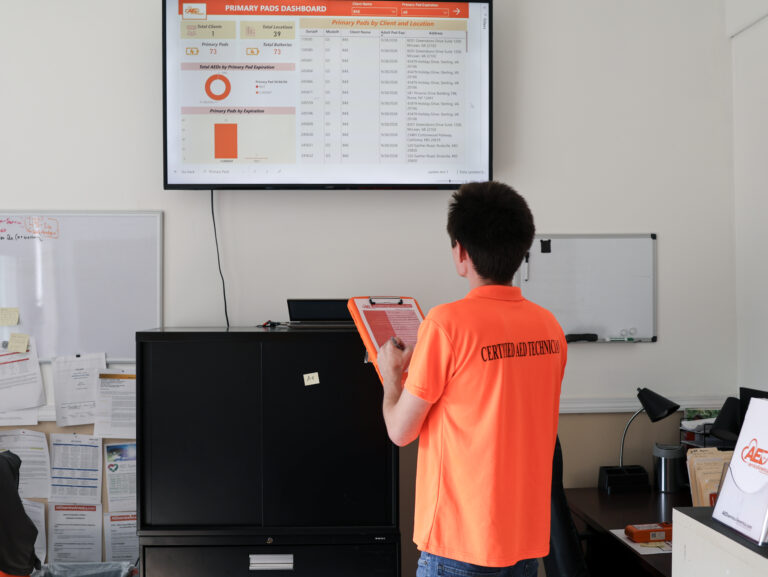
Our company maintains the program records, equipment information, maintenance schedules, and documentation necessary to support continued oversight.
These records include information such as:
- AED manufacturer, model, serial number, and location.
- Battery installation dates and scheduled replacement dates.
- Electrode pad expiration dates and applicable component lot numbers.
- Manufacturer recall and field corrective action information.
- Inspection histories and documented findings.
- Maintenance activities and corrective actions.
- A chronology of equipment-related events and service history.
- Upcoming maintenance and replacement requirements.
When a new person assumes responsibility within the client’s organization, we can help bring that individual up to speed.
They do not have to reconstruct years of equipment history or start the management process from scratch.
They have access to an established maintenance program with documented information and continuity of oversight.
AED Management Should Survive Organizational Change
Mergers, acquisitions, employee turnover, retirements, and management restructuring are normal parts of business.
An effective AED management program should be designed to withstand those changes.
At AED Service America, we believe that continuity is one of the most valuable benefits of professional AED management.
Our clients should not have to worry that their entire AED program will become disorganized simply because the person who previously oversaw it is no longer there.
There should be a system in place.
There should be accurate records.
There should be clear responsibility.
And there should be an established process for maintaining the equipment regardless of personnel changes.
The responsibility for keeping an AED Response-Ready should not disappear when an employee walks out the door.
7. Compliance Is Important. Best Practices Matter Too.
Every AED owner should understand and follow applicable manufacturer instructions, laws, and regulatory requirements.
But at AED Service America, we believe meeting minimum requirements should not necessarily be the endpoint of responsible AED management.
Over the years, our experience has led us to implement additional procedures that we consider best practices.
These include manufacturer audits, documentation of battery installation dates, proactive replacement policies where appropriate, component lot-number tracking, comprehensive onsite inspections, and detailed maintenance records.
Not every one of these activities is expressly required in every jurisdiction or by every manufacturer.
Nevertheless, we believe they contribute to better oversight, traceability, and accountability.
These procedures require additional time, attention, and investment.
But we believe they are worthwhile.
Because the purpose of an AED maintenance program should not simply be to demonstrate compliance.
Its purpose should be to reduce the likelihood of preventable equipment problems when someone’s life may depend on the device.
8. Protecting Lives While Preserving Your Investment
Responsible AED management is not simply about replacing equipment.
It is also about helping organizations make informed decisions concerning the equipment they already own.
One common misconception is that an AED must automatically be replaced when its manufacturer’s warranty expires.
That is not necessarily true.
Depending on the device’s condition, manufacturer support status, available replacement components, and applicable safety information, an AED may remain suitable for continued service beyond its warranty period.
At AED Service America, our primary focus is onsite AED maintenance and management.
Although we also sell AEDs, we believe our responsibility is to recommend what the client actually needs.
Sometimes that means recommending replacement equipment.
Other times, it means replacing a battery, installing new electrode pads, completing a corrective action, or continuing to maintain an existing AED that remains appropriate for service.
We believe the best way to earn a client’s trust isn’t always by selling them something new.
Sometimes it’s by telling them when they don’t need to buy it.
Our objective is to help clients preserve capital while maintaining appropriate safety standards.
9. From AED Ownership to AED Readiness
Purchasing an AED is an important commitment to the safety of others.
But the purchase itself does not create a complete AED program.
A responsible program requires ongoing maintenance, appropriate inspections, manufacturer awareness, accurate documentation, suitable storage conditions, and clearly assigned responsibilities.
These elements work together to help reduce the likelihood of equipment-related problems during an emergency.
At AED Service America, we believe AED maintenance is about more than batteries, electrode pads, and inspection reports.
It’s about protecting people.
It’s about earning trust.
And it’s about understanding that the work performed today may have a direct impact on someone’s life tomorrow.
That’s why we remind our technicians:
“Take your time. Do it right. Because the AED you inspect this morning may save someone’s life this afternoon.”
The Bottom Line: Owning an AED Is Only the Beginning
An AED is not a purchase that should be made and forgotten.
It is an ongoing responsibility.
- Batteries require monitoring.
- Electrode pads expire.
- Environmental conditions matter.
- Manufacturer recalls must be investigated.
- Professional inspections and accurate documentation are important.
And someone must be accountable for ensuring that these responsibilities are carried out.
But that accountability must also survive personnel changes, mergers, acquisitions, and organizational restructuring.
At AED Service America, we believe that effective AED management begins with understanding a simple truth:
Purchasing an AED is a one-time decision. Keeping it Response-Ready is an ongoing responsibility.
Because when someone’s life depends on an AED, the most important question isn’t whether you own one.
It’s whether that AED is truly ready when it’s needed.
Let AED Service America Help Keep Your AEDs Response-Ready
AED Service America provides nationwide onsite AED maintenance and management, including comprehensive inspections, manufacturer audits, battery and electrode pad management, recall monitoring, and ongoing program oversight.
Whether your organization has a single AED or devices deployed across multiple locations, our goal is to help you maintain an effective, accountable, and Response-Ready AED program.
Contact AED Service America to learn more about our nationwide maintenance and management services.
Educational disclaimer: AED maintenance requirements, self-test capabilities, replacement intervals, and storage limits vary by manufacturer and model. Always follow current manufacturer instructions, applicable safety notices, and relevant legal requirements.
Keep Reading
Related Articles
Is Your AED Really Response-Ready?
Learn why a green AED status indicator may not reveal expired pads, environmental damage or other maintenance concerns.
Read article
AED Inspection Checklist: The Complete Guide
Explore what a professional AED inspection can include, from battery and pad checks to documentation and device-specific procedures.
Read article
The True Health of Your AED
Learn why AED manufacturer audits, component tracking and warranty status matter for continued safe service.
Read articleIs Your AED Program Response-Ready?
AED Service America provides nationwide onsite AED maintenance and management, including comprehensive inspections, manufacturer audits, battery and electrode pad management, recall monitoring and ongoing program oversight.
Phone: 860-970-3250
Email: support@aedserviceamerica.com