
Aviation & Airports
AED Maintenance & Management for Aviation, Airlines & Airports
Protecting passengers, flight crews and airport personnel—on the ground and in the air.
In aviation, an automated external defibrillator (AED) is more than emergency medical equipment. It is a critical component of passenger safety, regulatory compliance and operational readiness.
Unlike AEDs installed in traditional facilities, aircraft AEDs operate in demanding conditions. Changing temperatures, frequent aircraft movement, vibration, repeated flight cycles and tight departure schedules create unique maintenance challenges.
AED Service America specializes in compliant, on-site AED maintenance and management in all 50 states, with aviation-specific programs designed for commercial airlines, aircraft operators, airport authorities and aviation facilities.
Our objective is straightforward: Keep every AED Response-Ready while minimizing disruptions to aviation operations.
Our Singularity of Focus Is What Sets Us Apart
AED maintenance and management is not one of the many things we do. It is what we do.
Aircraft AEDs
Aircraft AED Maintenance: A Specialized Approach
AEDs carried aboard aircraft require particular attention because they are not permanently stationed in conventional buildings. Depending on aircraft operations and storage conditions, devices may experience temperature fluctuations, vibration, repeated handling and frequent changes in location.
These conditions make it important to establish appropriate inspection schedules, consistent equipment tracking and dependable replacement procedures. AED Service America works with aviation clients to develop programs addressing:
- Customized inspection intervals: Scheduled inspections based on manufacturer instructions, applicable aviation regulations, aircraft operating conditions and the airline’s approved procedures.
- Temperature and environmental exposure: Verification that storage and operating conditions remain within device and battery manufacturer specifications.
- Equipment and accessory verification: Readiness indicators, electrode pads, batteries, expiration dates, physical condition and relevant documentation.
- Fleet-level tracking: Device serial numbers, aircraft assignments, inspection histories, maintenance records and planned replacement schedules.
- Verified documentation: Inspection records designed to support airline safety personnel, internal audits and applicable compliance requirements.
Because aircraft operating conditions can differ from conventional facilities, more frequent AED inspections may be appropriate. Actual intervals should be established in coordination with the operator’s approved program and device manufacturer requirements.
Hub Loaner Banks
Aviation Hub AED Loaner Banks: Keeping Aircraft Response-Ready
A distinguishing feature of AED Service America’s aviation model is its hub-based replacement program. When an onboard AED is found to be out of service, providing a compliant replacement quickly can be as important as servicing the affected unit.
AED Service America can establish dedicated banks of aviation-compatible loaner AEDs at designated hubs, supported by technicians located near participating aviation facilities.
Exchange Program
How the Aircraft AED Exchange Program Works
- 1. Issue identified: Authorized airline personnel identify an AED that is out of service, damaged or otherwise unsuitable for continued use.
- 2. Replacement retrieved: Authorized personnel obtain a pre-inspected, aviation-compatible AED from the designated hub loaner bank.
- 3. Equipment exchanged: The replacement is placed aboard in accordance with the airline’s approved equipment and operational procedures; the affected AED is transferred to the designated exchange location.
- 4. Technician service: AED Service America inspects and services the affected device or coordinates repair or replacement as appropriate.
- 5. Records updated: Device status, serial numbers, aircraft assignment, inspection results and loaner inventory are reconciled, and the bank is replenished.
This model helps operators maintain access to serviceable AEDs, reduce operational interruptions and limit delays caused by unavailable equipment. All substitutions must meet the operator’s approved configuration and applicable regulatory requirements; the aircraft operator determines dispatch eligibility.
FAA Compliance
FAA Requirements and Aircraft AED Compliance
Under 14 CFR § 121.803, certain Part 121 passenger-carrying aircraft must carry an approved AED, including aircraft meeting the regulation’s flight-attendant and payload criteria. Applicable emergency medical equipment must be accessible, appropriately maintained and inspected at established intervals.
Required equipment that is missing or unserviceable can affect dispatch authorization. The precise operational consequence depends on applicable FAA requirements, approved aircraft equipment lists and the operator’s procedures.
AED Service America supports operators with inspection coordination, equipment tracking, consumables management and documented service. Our work supports—but does not replace—the airline’s approved procedures, aviation maintenance responsibilities or FAA oversight.
Regulatory sources: 14 CFR § 121.803 — Emergency medical equipment · FAA Advisory Circular AC 121-33B — Emergency Medical Equipment
TSO Requirements
FAA TSO Requirements for Aircraft AEDs: What Aviation Operators Need to Know
Not all AEDs and AED batteries are suitable for every aviation application.
Aircraft operators must consider more than whether an automated external defibrillator is FDA-cleared and functioning properly. Depending on the aircraft’s operating category and applicable FAA requirements, additional standards may apply to the AED’s power source, storage, accessibility, maintenance, and documentation.
What Does TSO Stand For?
TSO stands for Technical Standard Order, an FAA minimum performance standard for specified aviation equipment and components.
FAA TSO-C142 establishes performance requirements for certain lithium cells and batteries used in aviation applications, including power sources for emergency equipment.
A common misconception is that every AED carried aboard an aircraft must be TSO-certified. In fact, the applicable requirements depend on the aircraft’s operating rules, the AED’s power source, and the operator’s approved procedures.
Are TSO-Compliant AED Batteries Required on All Aircraft?
No. FAA requirements differ among commercial airlines, charter operators, corporate aviation, and privately operated aircraft.
Under 14 CFR Part 121, covered passenger-carrying commercial aircraft must carry an approved AED. Applicable FAA power-source requirements must also be satisfied.
Private aircraft and many charter operations are not subject to the same general AED carriage mandate. Nevertheless, aircraft owners and operators should verify that any AED carried onboard is appropriate for the aviation environment and consistent with applicable operating requirements. Our service plans include doing that homework for you.
Why Aviation AED Maintenance Requires Specialized Knowledge
AED Service America recognizes that maintaining an AED aboard an aircraft presents challenges that may not exist in traditional workplace environments. Aircraft AED programs require particular attention to:
- Manufacturer-approved battery specifications and applicable FAA requirements.
- Battery expiration dates, replacement intervals, and traceability.
- Environmental exposure, including temperature fluctuations and storage conditions.
- Electrode pad expiration and packaging integrity.
- Device readiness, manufacturer recalls, and service advisories.
- Aircraft identification, location tracking, and maintenance records.
- Post-use restoration and prompt return to service.
Nationwide Aviation AED Maintenance & Management
AED Service America provides onsite AED maintenance and management services for aviation operators throughout the United States and Canada.
Our approach combines manufacturer-specific maintenance procedures, detailed documentation, proactive replacement planning, and coordinated onsite service to help aviation operators maintain Response-Ready AED programs.
Because an AED at 35,000 feet deserves the same attention to readiness as one on the ground.
Questions About Aircraft AED Requirements?
Whether you manage a commercial airline fleet, corporate aviation operation, charter service, or private aircraft, AED Service America can help you evaluate your AED maintenance program and identify equipment requirements that warrant verification with the manufacturer and applicable aviation authority.
Airports
Airport AED Maintenance & Management
Airport terminals create a different set of challenges. Large footprints, multiple security zones, passenger congestion and 24-hour activity require carefully planned AED availability and access.
Strategic AED Placement and Site Assessments
We help airport operators determine the number and placement of AEDs, considering check-in areas, security checkpoints, airside and landside locations, boarding gates, baggage claim, transportation areas, employee-only spaces and other high-traffic facilities. Placement planning aims to make AED retrieval and delivery as rapid as practical. A three-minute target may be used as a planning objective.
AED Selection for High-Traffic Facilities
An airport AED may be used by a traveler, airline employee, security officer or other person with limited training. We help select equipment for ease of use, clear audible and visual prompts, reliability, accessibility, environmental fit and alignment with response procedures. Fully automatic AEDs may be especially suitable for lay-responder settings when appropriate and permitted.

Planning & Documentation
Emergency Response Planning & Verified On-Site Inspections
Emergency Response Planning
We can assist with AED-related response protocols addressing public and restricted zones, coordination with airport emergency responders, device accessibility, employee familiarization and post-incident readiness restoration.
On-Site Inspections and Verified Documentation
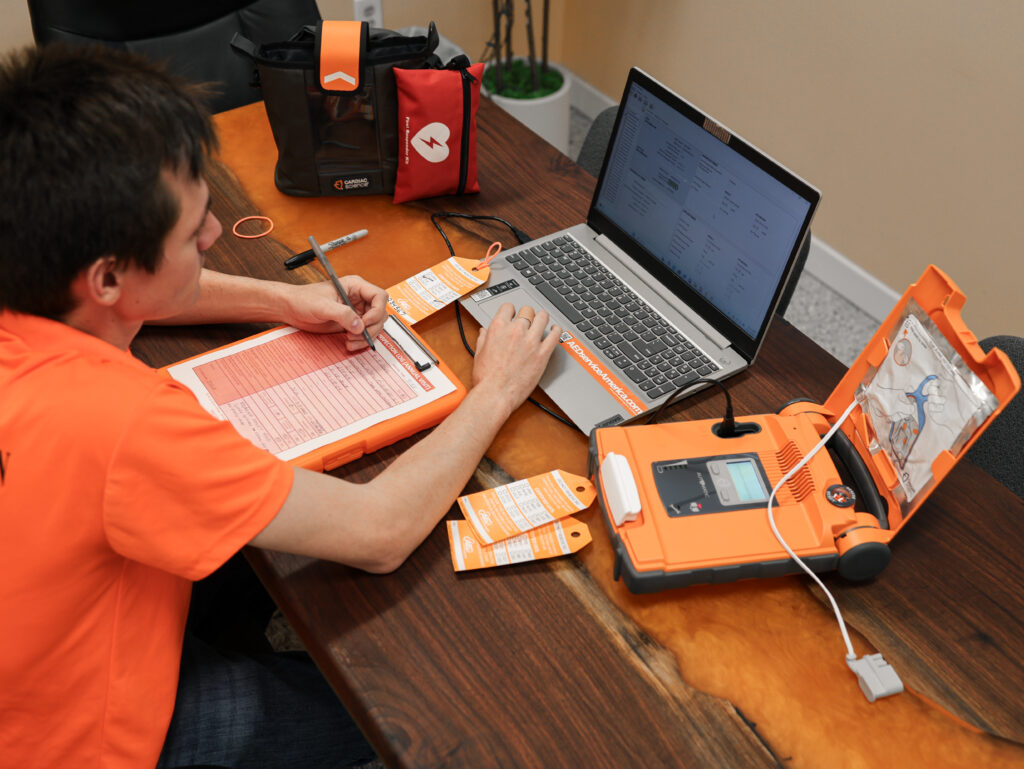
Our Response-Ready Technicians physically inspect AEDs and record device condition, battery and pad status, serial numbers and appropriate photographic verification. Field reporting and account-manager review provide visibility, accountability and defensible documentation across airport properties and facilities.
Why Us
Why AED Service America?
We are not a general facilities vendor offering dozens of unrelated services. AED maintenance and management is our singular focus. Lifesaving emergency equipment deserves specialized attention—not simply another line item in a broad facilities program.
- Singularity of Focus: Specialized attention to compliant on-site AED maintenance and management, with aviation-specific operating workflows.
- Verified Documentation: Physical inspections, detailed field records, photographs and account-manager review.
- Responsive Service: Nationwide technician coverage and dedicated aviation hub loaner banks designed to address out-of-service devices promptly.
Frequently Asked Questions
Are AEDs required on commercial aircraft?
Yes, for aircraft subject to applicable FAA Part 121 requirements. Other aircraft operations may have different requirements.
Do aircraft AEDs need more frequent inspections?
They may, depending on exposure, handling and the applicable program. Inspection intervals should follow manufacturer instructions, regulations and the operator’s approved procedures.
Can airlines keep replacement AEDs at their aviation hubs?
Yes, where replacements conform to approved equipment configurations and operational procedures. AED Service America can help establish and manage hub-based loaner banks.
Does AED Service America help with airport AED placement?
Yes. We support airport site assessments, AED selection, placement planning, on-site maintenance and AED-related response protocols.
Can AED Service America manage AEDs across multiple airports and aviation hubs?
Yes. Our nationwide network supports coordinated inspections, standardized documentation and centralized account management across multiple locations.
Protect Your Passengers. Protect Your Crews. Protect Your Operations.
Whether your organization operates a commercial aircraft fleet, an airport terminal, an aviation maintenance facility or multiple aviation hubs nationwide, AED Service America can help build a dependable, documented AED maintenance and management program.
Contact AED Service America to discuss aviation AED inspections, airport AED management and dedicated aircraft AED loaner programs.
Aviation requirements, aircraft specifications and AED manufacturer instructions change. Verify all applicable FAA rules, approved aircraft configurations and operating procedures before deploying or modifying an onboard AED program. AED Service America’s services support compliance but do not substitute for an operator’s regulatory responsibilities.
Phone: 860-970-3250
Email: support@aedserviceamerica.com