Warehousing & Distribution
Warehouse & Distribution Center AED Management
Nationwide AED Placement, OSHA-Related Safety Planning & Hands-On Maintenance
Warehousing and distribution centers face unique challenges when preparing for a sudden cardiac arrest emergency. Expansive floor plans, high ambient noise, long travel distances, loading docks, automated equipment, restricted-access areas, and multiple shifts can all complicate an effective emergency response.
AED Service America helps warehousing and distribution operations develop, implement, and maintain an automated external defibrillator (AED) program designed around the realities of their facilities. Whether you operate a single distribution center or manage a nationwide network of warehouses, fulfillment centers, and logistics facilities, we provide the expertise and hands-on service needed to keep your AEDs accessible, properly maintained, and ready for use.
Our services go well beyond purchasing an AED or receiving an automated maintenance reminder. We help organizations evaluate their facilities, determine appropriate AED locations, select suitable equipment, develop cardiac emergency response plans, coordinate applicable registration requirements, and maintain their devices through physical, onsite service.
48 hrs
Contractual onsite response commitment after notification that an AED is out of service
4 hrs
Historical onsite response for deployed or out-of-service AEDs over the past five years*
50
States served with hands-on AED maintenance and management
*Historical performance, not a contractual guarantee.
Our Singularity of Focus Is What Sets Us Apart
AED maintenance and management is not one of the many things we do. It is what we do.
Strategic Placement
Strategic AED Placement for Large Warehouse Facilities
In a warehouse or distribution center, the location of an AED can make a critical difference. A device positioned too far from a work area may delay treatment during the minutes when early defibrillation matters most.
AED Service America can conduct a site analysis using facility blueprints and floor plans or work with your team to evaluate the physical environment. Our recommendations take into account:
- Facility size and layout: Building dimensions, storage racks, mezzanines, production areas, and the distances between workstations and potential AED locations.
- Response-time objectives: Evaluating the time required to retrieve an AED and return to a potential patient, using a brisk walking pace and a stopwatch rather than estimating distances from a blueprint alone.
- Restricted-access areas: Locked doors, security checkpoints, employee-only zones, and other barriers that could delay access to a device.
- High-activity work zones: Shipping and receiving areas, loading docks, conveyor systems, picking and packing stations, equipment charging areas, and other locations where employees regularly work.
- Multiple shifts and remote areas: Ensuring that AED access and emergency procedures remain effective during overnight operations, weekends, and periods of reduced staffing.
- Visibility and accessibility: Clear AED signage, appropriate mounting locations, unobstructed access, and identification of devices on facility maps and emergency response materials.
The American Heart Association’s AED implementation guidance recommends planning for an AED to be retrieved and returned to a patient within approximately three to five minutes. AED Service America uses a more aggressive three-minute round-trip objective as a planning target where feasible, with actual placement recommendations determined by the facility’s layout, operational risks, and applicable requirements.
In expansive distribution environments, this analysis may demonstrate the need for additional AEDs rather than relying on a single centrally located device.
Equipment Selection
Selecting the Right AED for a Noisy Industrial Environment
A warehouse is not a quiet office. Conveyor systems, forklifts, powered industrial trucks, ventilation equipment, packaging machinery, and general operational noise can make it difficult for a rescuer to hear an AED’s spoken instructions.
AED Service America evaluates device features in the context of the actual environment. Depending on the facility, we may recommend an AED with both audible voice prompts and a full-text display that presents instructions visually.
This combination provides an additional way for a rescuer to understand the device’s instructions when ambient noise interferes with audible prompts. Because sound levels and volume-adjustment capabilities vary by model, selecting the right device requires more than comparing purchase prices.
Our recommendations may also consider:
- Ease of use by employees with varying levels of AED experience.
- Clear, step-by-step prompts during a stressful emergency.
- Device durability and suitability for the intended environment.
- Electrode pad and battery availability, expiration monitoring, and replacement requirements.
- Manufacturer support, warranty coverage, and expected product life cycle.
- Compatibility with the organization’s existing AED inventory and emergency response procedures.
We help organizations select appropriate AED makes and models based on their operational needs, rather than taking a one-size-fits-all approach.
Workplace Safety
Workplace Safety, Hazard Assessment & Emergency Preparedness
Warehousing and distribution facilities may involve slips, trips, falls, elevated work areas, electrical hazards, powered equipment, and other occupational risks. These conditions make a coordinated emergency response particularly important.
AED Service America considers the operational characteristics of each facility when developing AED placement and management recommendations. We can help identify locations where an AED may be needed quickly, account for barriers that could delay access, and coordinate AED planning with the organization’s existing workplace safety procedures.
Our approach can address:
- AED placement in shipping, receiving, picking, packing, and distribution areas.
- Access considerations around loading docks, production lines, and equipment zones.
- Coordination with first-aid stations, emergency equipment, and designated response personnel.
- Emergency communication, 911 activation, and procedures for directing responding EMS personnel to the patient’s location.
- AED accessibility during all operating shifts and in secured or partially staffed areas.
- Integration of AED procedures into a broader cardiac emergency response plan.
An AED program should complement, not replace, an organization’s established occupational safety and emergency action plans.
OSHA & Program Support
OSHA Workplace Safety & AED Program Support
Warehousing and distribution operations must address workplace safety, emergency preparedness, and the specific hazards associated with their facilities. The Occupational Safety and Health Administration (OSHA) provides standards and guidance addressing workplace first aid, emergency planning, hazard assessment, and other aspects of employee safety.
AED Service America helps organizations incorporate AED placement, inspection, maintenance, and emergency response planning into their broader workplace safety programs. Our recommendations consider facility-specific risks, accessibility, manufacturer requirements, and applicable federal, state, and local requirements.
We can assist your organization with:
- Evaluating AED locations in relation to warehouse floor plans, work areas, and emergency access routes.
- Incorporating AED locations into facility maps and emergency response procedures.
- Maintaining AEDs in accordance with applicable manufacturer instructions and service requirements.
- Supporting appropriate coordination of CPR/AED training, designated responders, and local emergency medical services.
- Providing detailed inspection reports and service documentation to support your organization’s safety records and compliance efforts.
- Coordinating AED program management across multiple facilities to help standardize procedures and maintenance practices.
Our goal is to help you maintain a workplace AED program that is practical, well-documented, and integrated with your existing safety procedures.
OSHA requirements vary according to the workplace, applicable standards, and operating conditions. AED Service America supports AED program management and preparedness; our services do not replace an employer’s responsibility to determine and satisfy all applicable regulatory requirements.

Emergency Planning
Cardiac Emergency Response Plans & Program Coordination
Having an AED in a building is only one component of an effective emergency preparedness program. Employees must know how to summon help, locate the nearest device, begin CPR, and coordinate with emergency medical services.
AED Service America assists organizations in developing cardiac emergency response plans tailored to their facilities and workforce. Depending on the organization’s needs and applicable state and local requirements, this can include:
- Documenting AED locations and identifying the devices available in each area.
- Establishing procedures for calling 911, initiating CPR, retrieving the AED, and coordinating responders.
- Helping identify and coordinate CPR/AED training for designated employees.
- Supporting applicable AED registration and notification with the appropriate local EMS authority or governing agency.
- Coordinating medical direction or oversight where required.
- Establishing maintenance, inspection, recordkeeping, and post-deployment procedures.
For organizations operating multiple distribution centers across different states, coordinating these activities can be particularly challenging. AED Service America helps clients manage their programs with a consistent approach while accounting for differences in local requirements.
Onsite Maintenance
Nationwide Onsite AED Maintenance & Compliance Management
A properly selected and strategically positioned AED must also be maintained throughout its service life. Expired electrode pads, depleted batteries, unresolved device alerts, product recalls, and other maintenance issues can compromise readiness when a device is needed.
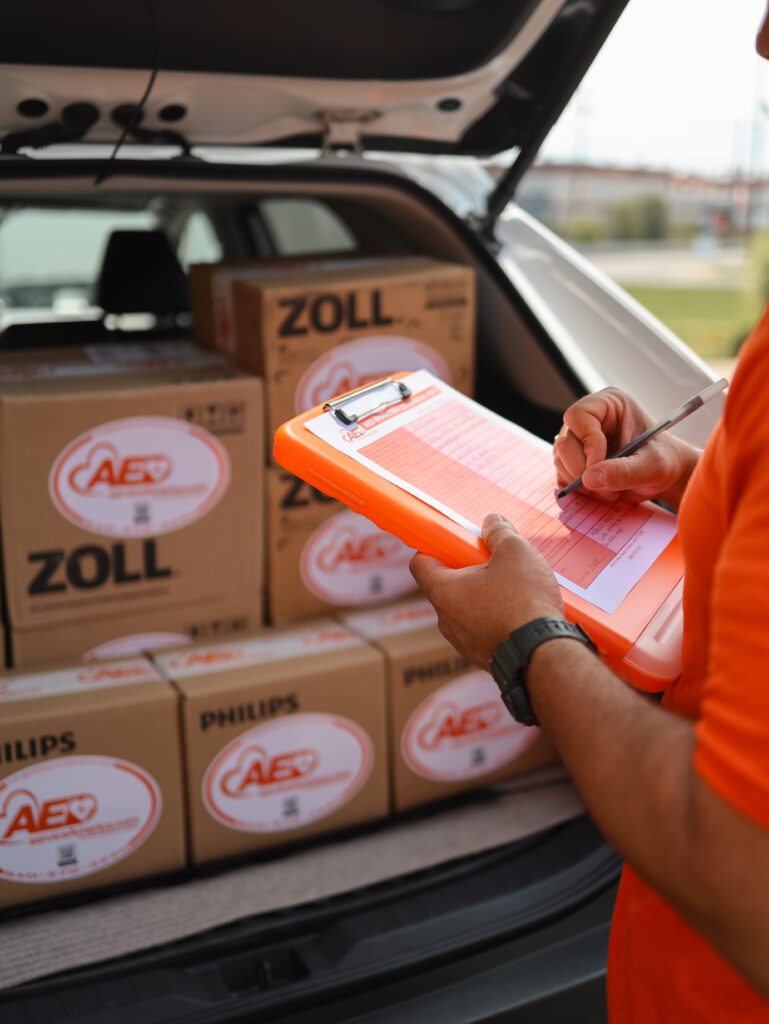
AED Service America specializes in physical, onsite AED inspection and maintenance—not simply software reminders or instructions for employees to check their own equipment.
Our trained technicians visit client facilities to inspect AEDs, verify device readiness, identify maintenance needs, and replace applicable components. Our service process includes detailed field documentation and reporting, helping organizations maintain a defensible record of their AED maintenance activities.
Our ongoing management can include:
- Physical onsite AED inspections and maintenance.
- Electrode pad and battery expiration tracking, including applicable lot-number documentation.
- Identification and resolution of maintenance issues and out-of-service devices.
- Manufacturer recall, safety notice, warranty, and end-of-life monitoring.
- Equipment inventory and serial-number documentation.
- Inspection reports with photographs and recorded service findings.
- Online access to service records and maintenance documentation.
- Coordination of replacement equipment and components as needed.
For organizations with multiple warehouses or distribution centers, this hands-on approach provides a consistent way to manage AED readiness across locations without placing the entire burden on local employees.
Rapid Response
When an AED Is Deployed, Response Time Matters
When an AED is used in a cardiac emergency, it may be unavailable for another emergency until it has been inspected, restored to service, and supplied with any required replacement components.
For a busy distribution center operating around the clock, leaving a critical emergency-response device out of service creates an avoidable gap in preparedness.
AED Service America’s contractual onsite response commitment is within 48 hours of notification that an AED is out of service. Historically, over the past five years, our technicians have been onsite within four hours when responding to calls involving deployed or out-of-service AEDs.
This level of responsiveness is especially valuable in large distribution facilities, where employees may be spread across substantial floor areas and multiple shifts depend on reliable access to emergency equipment.
Our objective is to restore readiness as quickly as possible, with physical technician support rather than relying solely on remote instructions or an automated service ticket.
Multi-Site Programs
One Nationwide Partner for Every Facility
Managing AEDs across a network of warehouses can create substantial administrative work for environmental health and safety (EHS) teams, risk managers, facilities personnel, and corporate safety directors.
Coordinating different vendors, tracking expiration dates, verifying inspection records, and responding to out-of-service devices across multiple states can consume time that would be better spent on other safety priorities.
AED Service America provides nationwide AED program management for organizations seeking a consistent, hands-on approach across their facilities.
Whether you manage one regional warehouse, a large fulfillment operation, a third-party logistics (3PL) network, or hundreds of distribution locations, we can help coordinate equipment selection, strategic placement, emergency planning, ongoing maintenance, and service documentation.
Our experience spans every major AED brand and facilities throughout all 50 states. We work to make AED management simpler for your team while helping ensure that equipment is accessible, maintained, and ready when it matters most.

Your Workforce
Protect Your Workforce With a Better AED Program
Your employees depend on effective safety procedures and reliable emergency equipment. AED Service America helps you bring those elements together through facility-specific planning, appropriate AED selection, cardiac emergency response planning, and professional onsite maintenance.
No one is more uniquely qualified to help manage your organization’s onsite AED program than a partner dedicated to keeping AEDs ready for use.
Request a Warehouse AED Assessment
AED Service America — Nationwide, Hands-On AED Management. Peace of Mind Guaranteed.
Contact AED Service America to discuss an AED placement assessment, a new warehouse AED program, or nationwide management of your existing distribution facilities.
Phone: 860-970-3250
Email: support@aedserviceamerica.com