Manufacturing
Manufacturing AED Management, Maintenance & Compliance Services
Nationwide AED programs designed around real manufacturing environments.
In a manufacturing facility, heavy machinery, high noise levels, large production floors, restricted access and multiple shifts can complicate emergency response. Simply mounting an AED on a wall is not enough.
AED Service America helps manufacturers select, position, maintain and manage AEDs around the way their facilities actually operate. From a single plant to a multi-state network, our goal is to help keep every AED accessible, properly maintained and Response-Ready.
48 hrs
Contractual response commitment for reported out-of-service AEDs
4 hrs
Historical on-site response for 100% of reported events over the past five years*
50
States with on-site AED services and training
*Historical performance, not a contractual guarantee.
Our Singularity of Focus Is What Sets Us Apart
AED maintenance and management is not one of the many things we do. It is what we do.
Protocols
Emergency Response Protocols Built for Your Facility
Every manufacturer should have a clear cardiac emergency response protocol. We help clients establish practical procedures for recognizing an emergency, activating 911 and internal responders, starting CPR, locating an AED, and coordinating with arriving EMS. We consider shift coverage, security checkpoints, communications, and the safe shutdown of nearby equipment where necessary.
Device Selection
AED Selection for Noisy Industrial Environments
Voice instructions can be difficult to hear around production machinery. Where ambient noise is a concern, we evaluate AEDs with visual and written instructions that complement audible prompts. These features can also assist deaf or hard-of-hearing responders. We review the actual device interface rather than assuming every AED with a screen provides equivalent guidance.
Placement
Strategic AED Placement and Real-World Retrieval Times
Our site analysis considers travel distances, floors, separate buildings, stairways, locked doors, badge-only access, shift staffing and other barriers. An AED behind a swipe-card door may be unavailable to most employees when seconds count.
We recommend timed retrieval walk-throughs from representative work areas, measuring the entire process of getting the AED back to the patient—not just the distance to the cabinet. Our preferred planning goal is to make pad application possible within approximately 60–90 seconds wherever feasible. This is an AED Service America design objective, not a universal legal standard; actual placement should reflect each facility’s circumstances.
Existing Equipment
Preserving Your Existing AED Investment
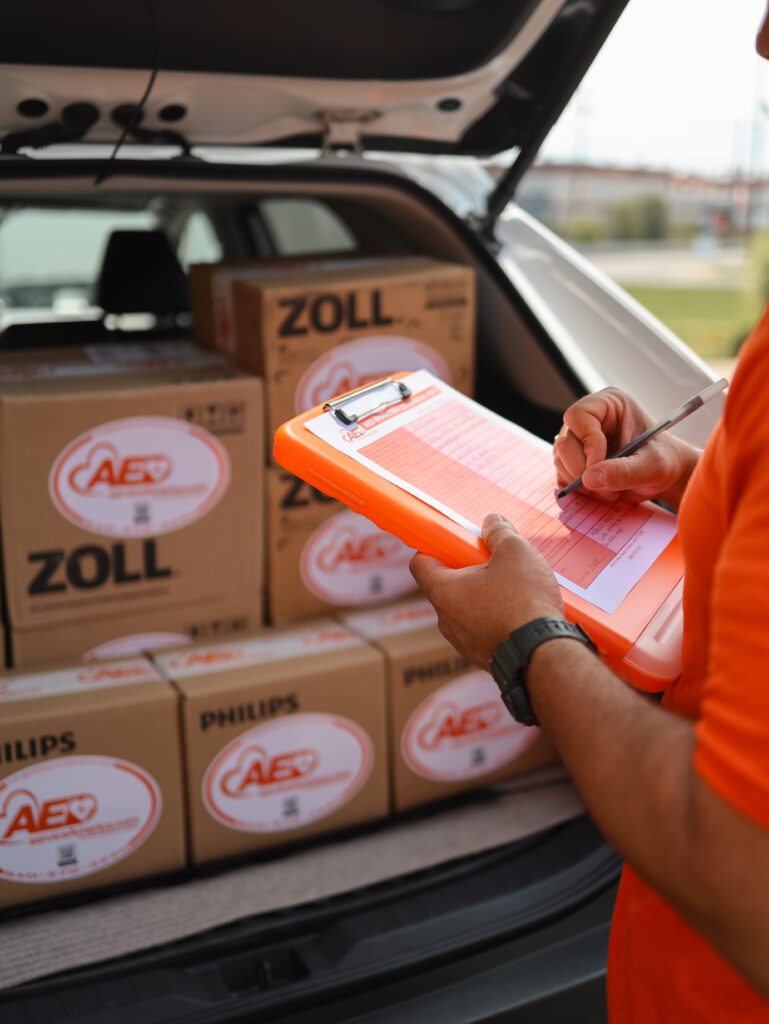
Before suggesting replacement devices, we audit the AEDs you already own. Our review can include make, model, serial number, manufacturer support status, recalls and advisories, device condition, and consumable expiration dates. When needed, we seek clarification from the manufacturer about continued service eligibility. If existing AEDs remain appropriate and serviceable, our goal is to help you retain them and preserve capital.
Inspections
Annual On-Site Inspections and Ongoing Maintenance
Our comprehensive annual on-site AED inspections review device condition, operational indicators and applicable manufacturer checks, pads, batteries, and service records. Daily, weekly or monthly visual status-indicator verifications are distinct from comprehensive annual inspections. We coordinate documentation, consumable replacement and follow-up corrective actions through our service plans.

Training
AED/CPR and First Aid Training for Every Shift
AED Service America provides on-site AED/CPR and First Aid training across all 50 states. We help facilities plan training around production schedules and first-, second- and third-shift responder coverage, so emergency readiness does not end when the day shift leaves.
Multi-Site
Centralized Management for Multi-Site Manufacturers
Different plants often have different AED models, expiration dates, local requirements and designated responders. We coordinate equipment inventories, inspection records, maintenance, training and applicable state and local compliance support through one accountable provider and one point of contact. Whether you have one AED at one location or 32 facilities in 28 states, we can support your program nationwide.
Considerations
Additional Manufacturing-Specific Considerations
- High ambient noise and the need for readable visual AED instructions
- Dust, moisture, vibration, washdown areas and temperature-sensitive storage
- Badge-controlled doors, secured production zones and visitor access
- Multiple buildings, mezzanines, stairways and long retrieval routes
- Second- and third-shift responder coverage, turnover and temporary staffing
- Contractors, visitors and personnel unfamiliar with plant layouts
- Industrial hazards, PPE and safe coordination with equipment shutdown procedures
- Clear wayfinding, signage and unobstructed AED cabinets
- Recalls, manufacturer service advisories and replacement-pad/battery tracking
- Coordination with EHS teams and existing workplace emergency action plans
Why Us
Why Manufacturing Companies Choose AED Service America
- AED specialization: Our business is focused on AED maintenance, management and compliance support.
- Responsive service: Our contractual response commitment for reported out-of-service AEDs is 48 hours; our historical on-site response performance over the past five years has been within four hours for 100% of reported events.
- Verified reporting: Field inspection reports are reviewed and approved by an AED Service America account manager before the technician advances to the next AED.
- One accountable contact: Centralized support for geographically dispersed facilities.
- Nationwide capabilities: On-site AED services and training across all 50 states.
Flexible Services
Flexible Services—With or Without a Service Plan
Manufacturers may purchase individual AEDs, replacement pads and batteries, on-site AED/CPR and First Aid training, annual inspections, inventory audits, facility placement assessments and emergency response protocol assistance. A comprehensive AED service plan is available, but it is not required to purchase individual products or services.
Our Work Is Measured in More Than Inspections.
It’s measured in confidence, accountability, and readiness.
Manufacturing AED FAQs
Where should AEDs be placed in a manufacturing facility?
Place AEDs where they can be reached quickly from occupied work areas without passing through locked or badge-controlled barriers. Use timed retrieval drills and consider every shift, floor and separate building.
What AED is best for a noisy factory?
Choose a device appropriate to the environment and consider models with clear on-screen visual and written prompts in addition to voice guidance. Compare actual features and manufacturer environmental specifications.
Can an AED be used by a deaf or hard-of-hearing responder?
Some AEDs offer visual or written prompts that reduce reliance on audio. Evaluate the specific model and train responders on its interface; not every screen-equipped AED provides the same level of instruction.
How many AEDs does a manufacturing facility need?
There is no universal number for every plant. Facility layout, employee distribution, access barriers, retrieval time and applicable requirements should guide a site-specific recommendation.
How quickly should an AED be accessible?
Rapid CPR and defibrillation are critical. AED Service America aims for pad application within roughly 60–90 seconds where practical, using timed facility assessments; this is a planning objective rather than a universal legal requirement.
Can existing AEDs stay in service?
Often yes, if they remain supported, safe and serviceable. We assess equipment condition, serial numbers, recalls, manufacturer guidance and consumable availability before recommending replacement.
What is included in AED maintenance?
A program may include comprehensive annual on-site inspections, documented checks, consumable tracking, device records and corrective follow-up. Routine visual status-indicator verifications are not the same as comprehensive inspections.
Can you support facilities across multiple states?
Yes. AED Service America coordinates AED management and on-site services nationwide, while accounting for relevant state and local requirements.
Can training accommodate second- and third-shift employees?
Yes. On-site AED/CPR and First Aid training can be planned around plant operations and shift schedules.
Does OSHA require AEDs in every manufacturing plant?
Federal OSHA does not generally require an AED in every manufacturing workplace. Applicable state or local laws, industry requirements and the employer’s emergency response arrangements should be evaluated separately.
Make Your Manufacturing Facility Response-Ready
Let AED Service America help assess your current equipment, identify access and response-time gaps, preserve your AED investment and develop a practical, coordinated program. Contact us to discuss your facility or request a manufacturing AED program assessment.
Phone: 860-970-3250
Email: support@aedserviceamerica.com